What Wavelength Is Most Effective in Driving Photosynthesis
It has been used by more than 2 million students. The action spectrum indicated by the black line plot in the image above shows the relative effectiveness of each color of light in driving.
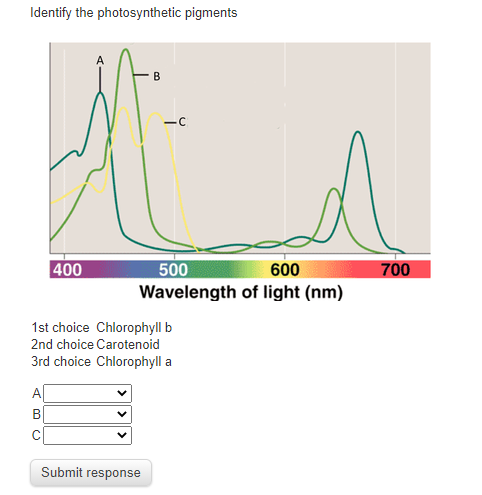
Solved Which Wavelengths Of Light Are Most Effective In Chegg Com
Preface The Essentials of Physical Chemistry has been written for BSc students.
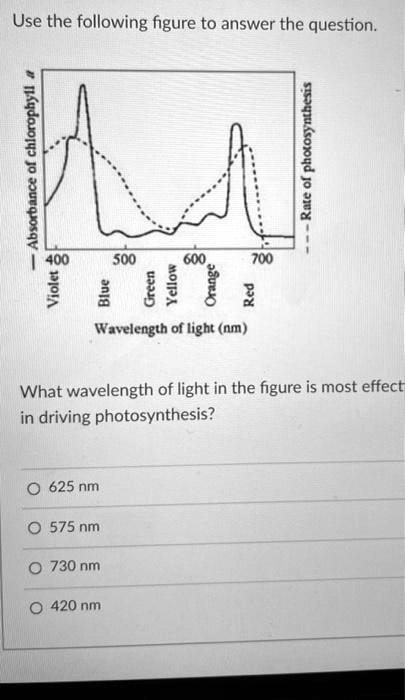
. What wavelength of light in the figure is most effective in driving photosynthesis. 6 H2O 1 6 CO2 S C6H12O6 1 6 O2 cellular respiration. Coupling this enzyme to photosynthesis was a pivotal event in the history of the earth as this reaction is the source of most of the oxygen in the earths atmosphere.
A 420 nm B 575 nm C 625 nm D 730 nm. In other words it sits in the peaks in chlorophyll absorption. Chlorophyll fluorescence is light re-emitted by chlorophyll molecules during return from excited to non-excited statesIt is used as an indicator of photosynthetic energy conversion in plants algae and bacteriaExcited chlorophyll dissipates the absorbed light energy by driving photosynthesis photochemical energy conversion as heat in non-photochemical quenching or by emission as.
This is related to the. Although photosynthesis can be improved by maximizing growth factors genetics plays a major role in the plants programmed. B Bacteria congregated in these areas because these areas had the most oxygen being released.
If the reaction instead follows a pre-equilibrium mechanism the observed rate constant depends on the equilibrium constant of the initial reaction. C6H12O6 1 6 O2 S 6 CO2 1 6 H2O 13. KU a fats i directly involved with inheritance b proteins ii range from small sugar c carbohydrates molecules to large starch d nucleic acids molecules iii responsible for.
Red light wavelengths particularly around 660nm encourage stem leaf and general vegetative growth but most commonly tall stretching of leaves and flowers. Two beakers redblue ink to represent dissolved minerals coloured. Engelmann illuminated a filament of algae with light that passed through a prism thus exposing different segments of algae to different.
Lidar ˈ l aɪ d ɑːr also LIDAR or LiDAR. Much evidence indicates that this event occurred just once giving all chloroplasts a. It is 26 editions old.
It has been national bestseller for more than 65 years. Sometimes LADAR is a method for determining ranges variable distance by targeting an object or a surface with a laser and measuring the time for the reflected light to return to the receiver. It really has been that long.
The driving force for the movement of electrons is provided by the differences in redox potential between the electron donor and the acceptor. Transpiration is the loss of water vapour from the parts of the plant that occur above the ground mainly the leaves. Match each macromolecule on the left with the most appropriate description on the right.
These can be manipulated by the grower to achieve maximum speed of growth and larger yields in a shorter period of time. The four heme moieties differ in the. Chloroplasts of eukaryotic cells arose from a symbiotic cyanobacterium see Fig.
There are factors other than the intensity and wavelength of the light that reaches the plants that affect the rate of photosynthesis. Red light is known to be the most effective light spectrum to encourage photosynthesis as its highly absorbed by chlorophyll pigments. It can also be used to make digital 3-D representations of areas on the earths surface and ocean bottom by varying the wavelength of light.
The most important factor is the suction force that is created by a process known as transpiration. In most cases of interest the reaction will have a relatively low driving force compared to the reorganization energy of the reaction ΔG 1 λ 1 and the equation simplifies to 12 ie α 05 in eq 9. Experiment-To show how plants absorb water and dissolved mineral salts Materials.
Cytochromes are identified by the type of heme moiety present a b c or d and the wavelength of maximal absorbance of the Soret band eg cytochrome b 559. By measuring oxygen production with aerotactic bacteria Engelmann described an action spectrum for photosynthesis. This distribution of bacteria shows that red and violet-blue wavelengths are most effective in driving photosynthesis.
Solved Use The Following Figure To Answer The Question 400 S00 600 700 1 W Wavelength Of Light Nm What Wavelength Of Light In The Figure Is Most Effect In Driving

Solved What Wavelength Of Light In The Figure Is Most Chegg Com
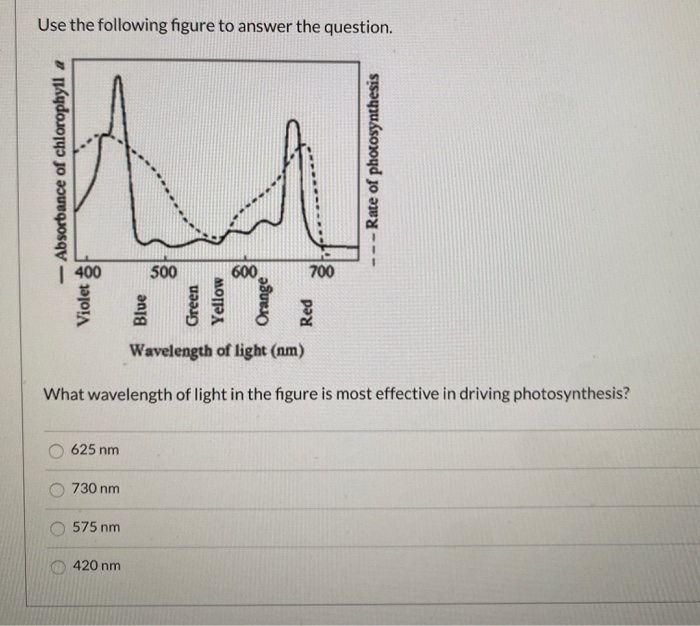
Solved Use The Following Figure To Answer The Question Chegg Com


Comments
Post a Comment